
A dynamic tool designed to quantify flexibility based on the operating conditions of devices and the real experiences of their users.
The Dynamic Flexibility Tool, developed by CARTIF partners within the framework of the REEFLEX Project, was conceived to explore the true potential of energy flexibility by combining technical, environmental, and behavioral aspects. Flexibility can be interpreted as the ability of smart assets to shift, shed, or curtail electrical demand in order to adjust the overall load of a system. Traditionally, this concept has been evaluated primarily through the electrical characteristics of the appliances involved. However, the real potential of flexibility can be understood more comprehensively when environmental conditions and typical usage behaviors are also included. This broader perspective formed the motivation for developing the Dynamic Flexibility Tool, designed to assess flexibility dynamically and contextually.
Conceptual Framework
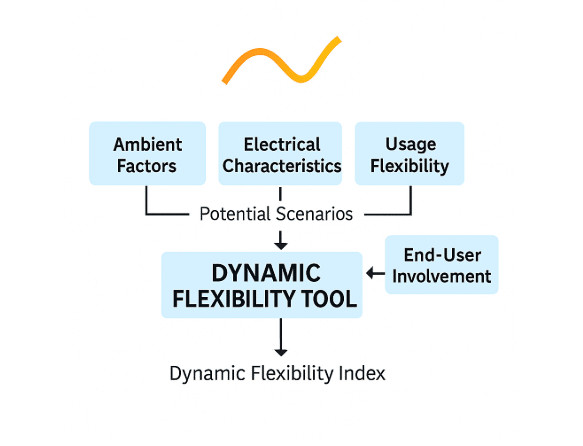
The operational context of assets reflects their ability to adapt to changing environmental conditions. This context can be represented through a series of scenarios structured along three dimensions considered critical for flexibility: ambient factors, electrical characteristics, and usage behavior. These scenarios are defined as sets of conditions that remain consistent over time but vary in their degree of deployment or technological sophistication.
Inspired by Smart Readiness concepts promoted by the European Commission, the Dynamic Flexibility Tool was developed to automatically compute the Dynamic Flexibility Index (DFI) of energy assets. The DFI builds upon three fundamental elements inherited from the classical Smart Readiness Indicator (SRI) framework: service groups, services, and functionality levels. What makes the DFI unique is its innovative approach that integrates end-user involvement into the assessment. The tool provides user-friendly guidelines, uses official European statistical data, and helps users select functionality levels intuitively while maintaining a robust technical foundation. As a result, the DFT goes beyond conventional assessments by incorporating qualitative data derived from both location and usage context.
Methodology and Service Groups
The developed tool encompasses nine asset domains: Domestic Hot Water (DHW), Heating, Cooling, Ventilation, White appliances, Lighting, Electric Vehicle Charging, Battery Energy Storage Systems (BESS), and Photovoltaic Systems (PV).
To evaluate the Dynamic Flexibility Index, the first step is to calculate the flexibility subindex for each service group. These are defined as follows:
• Ambient Factors: Evaluate internal and external conditions such as outdoor temperature, indoor humidity, building characteristics, and user comfort preferences that influence the frequency and timing of an asset’s use.
• Electrical Characteristics: Consider the amount of available power and the capacity of the asset to provide flexibility under different operating conditions.
• Usage Flexibility: Assess the adaptability of the asset through the shifting or shedding of its load within predefined time frames or operational constraints.
Within each service group, different scenarios are presented to users, who must select the functionality level that best represents the way their asset operates. To simplify this process, the tool provides clear descriptions explaining what each functionality level represents. Many of these descriptions rely on publicly available European Union statistics, which include interactive datasets and maps that help users understand scenarios based on their geographical location.
Supporting Resources and Data
To assist users, the tool includes references to key climatic and environmental indicators such as Heating Degree Days (HDD), Cooling Degree Days (CDD), Hot Days (HD), and Frozen Days (FD). These indicators help users identify environmental influences that affect energy consumption patterns.
Users may assess their scenarios through visual inspection of their surroundings or by reflecting on their typical comfort levels and usage habits. To ensure accuracy and consistency, the tool also provides an introductory user guide that includes a concise explanation of its structure, step-by-step instructions, essential guidelines for completing the process, and an example walkthrough. Additionally, it offers recommendations on how to interpret results and compare outcomes across different assets or scenarios.
Applicability and Use Cases
One of the greatest strengths of the Dynamic Flexibility Tool lies in its versatility. It can be used by manufacturers, researchers, energy planners, and end-users interested in understanding or maximizing the flexibility potential of assets.
As an illustrative example, consider a photovoltaic (PV) system, a technology that has become increasingly popular both at industrial and residential scales, including within energy communities. The static electrical characteristics of a PV system are usually well-documented in manufacturer datasheets. However, the flexibility assessment can be expanded by incorporating its operational context through scenarios such as:
• Objective Functionality: Refers to the configuration for the automatic operation of PV systems. Can the power output be modulated automatically based on factors like system efficiency, health, or lifespan considerations?
• Pairing with Storage Systems: PV flexibility is significantly enhanced when paired with a Battery Energy Storage System (BESS) capable of storing surplus energy. Is such a storage system available and can their joint operation be automated?
• Climate Conditions: Cloud cover and snow accumulation can affect PV performance and flexibility. Does the region experience frequent cloudiness or snow in winter, or are such events sporadic?
• Sizing of the Installation: Relates to the nominal capacity of the PV system. Was the installation sized to cover the average daily demand while potentially producing surplus energy?
• Usage Modes: Addresses how the PV system operates and interacts with the grid. Can generated power be used to meet internal load, stored for future use, or injected into the grid as needed?
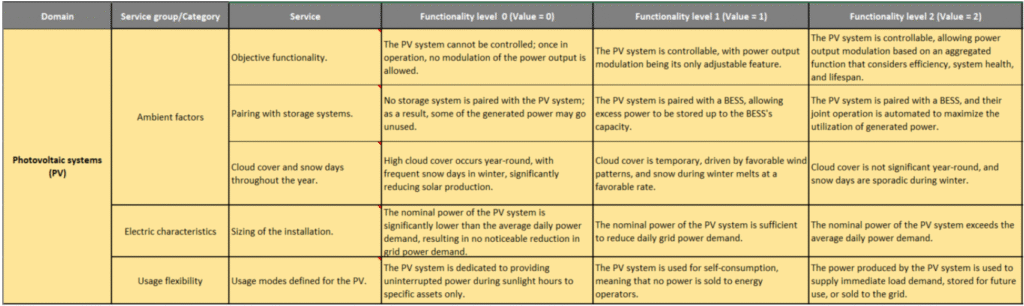
Each of these services is quantified through functionality levels ranging from 0 to 2, where 0 indicates a scenario of no flexibility and 2 represents the maximum achievable flexibility. Once the functionality levels are assigned, the corresponding subindices are computed and weighted to obtain a global DFI value.
Integration and Outcomes
The Dynamic Flexibility Tool incorporates the dynamic behavior of nine asset domains, bringing the concept of flexibility closer to end-users by reflecting the decisions they make daily or seasonally in the operation of their assets. Its modular design also allowed integration with complementary tools developed by other REEFLEX partners that focus on static flexibility assessment.
This integration enables a comprehensive methodological approach for computing the global flexibility index of assets, combining both static and dynamic evaluations. The methodology has been presented to experts in the field, who highlighted its innovative value as a decision-support tool for end-users and energy managers. By providing a transparent and replicable process for quantifying flexibility potential, the tool enhances confidence in energy system optimization and fosters collaboration between technology developers and consumers.
Conclusions and Future Outlook
The Dynamic Flexibility Tool represents a major step forward in the assessment of smart assets, enabling a richer and more accurate understanding of how flexibility operates in real-world conditions. By combining technical parameters, environmental influences, and user behaviors, it captures the full spectrum of factors that determine how flexible an asset truly is.
This holistic view not only supports energy efficiency and grid stability but also encourages a shift toward user empowerment, where individuals and organizations can make informed decisions about their energy assets. The approach aligns with Europe’s broader objectives for digitalization and decarbonization, emphasizing transparency, adaptability, and innovation.
For more information about the complete methodology, please refer to the following publication: Parada, L.C.; Fernández, G.; Camarero Rodríguez, R.; Martínez, B.; Spiliopoulos, N.; Hernamperez, P. Flexibility by Design: A Methodological Approach to Assessing Electrical Asset Potential Inspired by Smart Readiness Concepts. Appl. Sci. 2025, 15, 11334. https://doi.org/10.3390/ app152111334 Available at: https://www.mdpi.com/2076-3417/15/21/11334
Contact Information
For more information about REEFLEX, please contact us at: contact@reeflexhe.eu
Follow us on